Brotherly Love Concrete
Concrete Patios in Norfolk, VA
Brotherly Love Concrete builds concrete patios for homeowners in Norfolk and nearby Hampton Roads cities. A patio is the slab you actually spend time on, so the work covers layout for furniture and foot traffic, slope away from the house, and a finish that looks right and stays safe when wet.
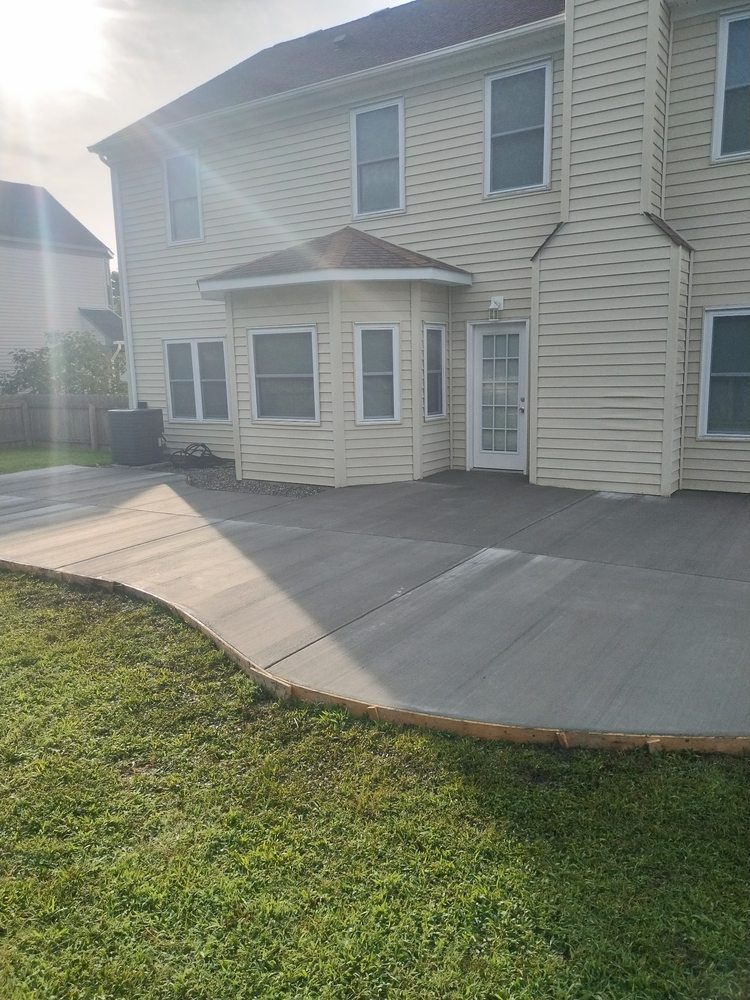
Laying out a patio
Layout deserves the most time, because a patio is sized for furniture and people rather than vehicles. A shape that looks generous marked out on the grass often feels tight once a table and chairs are on it and someone needs to walk behind a seat. Stand in the space with the outline marked and the furniture placed before anything is formed.
Shape is more open than on a driveway. Squares and rectangles are the simplest to form and the lowest in cost, while curves, angles and stepped edges take more forming time. That makes shape a trade between the look you want and the labor it takes to build.
Where the patio meets the house is the detail that matters most. The slab slopes away from the building, always, and it sits below any door threshold and below the siding line. A patio that drains back toward the house, or is poured too high against the wall, puts water exactly where it does the most damage.
Base, thickness and jointing
A patio carries far less weight than a driveway, so the slab is usually thinner. The base still matters. A corner that settles on a patio is more obvious than on a drive, because a table with one leg off the ground announces it immediately.
Excavation, removal of soft material and a compacted base go in the same way they do on any slab. On low ground, or a yard where water collects after storms, the subgrade can be wet when it is dug, and that gets corrected rather than covered.
Joints on a patio are seen up close, so the pattern is part of the design. NRMCA joint guidance recommends panels that are square or nearly so, no more than 1.5 times as long as they are wide, and warns against L shaped panels. Laying joints out to the shape of the patio keeps the pattern looking deliberate instead of cut in afterward.
Finishes
A broom finish is standard, and NRMCA's finishing guide describes brooming after floating as the way to give exterior concrete a non slip surface. A lighter broom texture feels softer underfoot. A steel trowel finish is smooth and slick when wet, which makes it a poor fit outdoors.
Decorative finishes are offered, including stamped and textured work and colored concrete. They are a different scope and a different price, and they should be settled at layout rather than after the forms are set, since some of them change how the slab is placed and finished.
Patios often connect to other flatwork. A pool deck that runs into a patio, or steps down from a back door, has to share one drainage plan so water is not passed from one slab to the next until it ends up at the house.
Pouring in warm weather
Many patios go in during the warm months, and heat changes the day. NRMCA's hot weather guide notes that concrete sets faster at higher temperatures, so finishing has to keep pace, and it recommends dampening the subgrade before placing on hot days without letting water pond. Early starts help on a summer pour.
Curing starts as soon as finishing is done. Keeping a new patio from drying out too fast in sun and wind protects the surface you will be walking on for years, and it is one of the least visible parts of the job.
Extending or replacing an existing patio
Extending a patio means tying new concrete to old, and the new section will not match the color of the existing one. Concrete cures to a shade that depends on the mix, the weather that week and its age. An extension meant to look seamless rarely does, so plan the layout as if the seam will show, for example by placing it at a step or a border.
Where an existing slab has settled or broken up, replacement often makes more sense than blending into it, and removal and replacement starts with finding out why it moved. Most patios that settled did so because of what was underneath, so the correction happens below the surface.
After the first year, a breathable sealer can help a patio shed water and stains; the NRMCA scaling guide lists sealing among the ways to protect exterior concrete. Patio work is offered in Norfolk and across the Hampton Roads service area.
Questions
Common questions
What size should a concrete patio be?
Size it for the furniture and the walking room around it rather than a number. An outline marked on the ground with the table and chairs in place tells you far more than a dimension on paper, and moving a line in the grass costs nothing compared to changing a slab later.
Can you match a new patio to my existing concrete?
Not exactly. New concrete cures to a shade set by the mix, the weather during the pour and time. An extension will look newer than the slab beside it, and the difference softens over the first year without ever disappearing, so placing the seam at a natural break helps.
What finish works well for a patio?
A broom finish is the standard because it gives grip when the surface is wet. A float finish is smoother and still workable outdoors. A steel trowel finish gets slippery in rain. Decorative and stamped finishes are offered and should be chosen before forming, since they change how the slab is placed.
Which way should a patio slope?
Always away from the house, with enough fall that rain runs off instead of sitting on the slab. The patio also needs to sit below the door threshold and below the siding line. Getting this wrong is expensive, because the damage shows up inside the house rather than in the concrete.
Can a patio be poured around an existing structure?
Yes. Patios are commonly poured around posts, columns, stoops, utility pads and the footings of a deck or pergola. Those spots get isolation joints so the patio and the structure can move independently instead of pulling against each other and cracking where they touch.
How long does a patio job take?
The pour itself usually happens in one day. The work around it takes longer: layout, excavation, base preparation and forming come first, and the slab needs curing time before furniture goes back on it. The schedule for your patio depends on its size, the finish and the weather.
Tell us about your project
Call, or send the project details and location through the estimate form.