Norfolk, VA
Concrete driveways in Norfolk and Hampton Roads
A driveway is the largest piece of concrete most properties will ever have, and it takes more load than anything else on the lot. New pours, widening, extensions and full replacement of a driveway that has reached the end of its life.
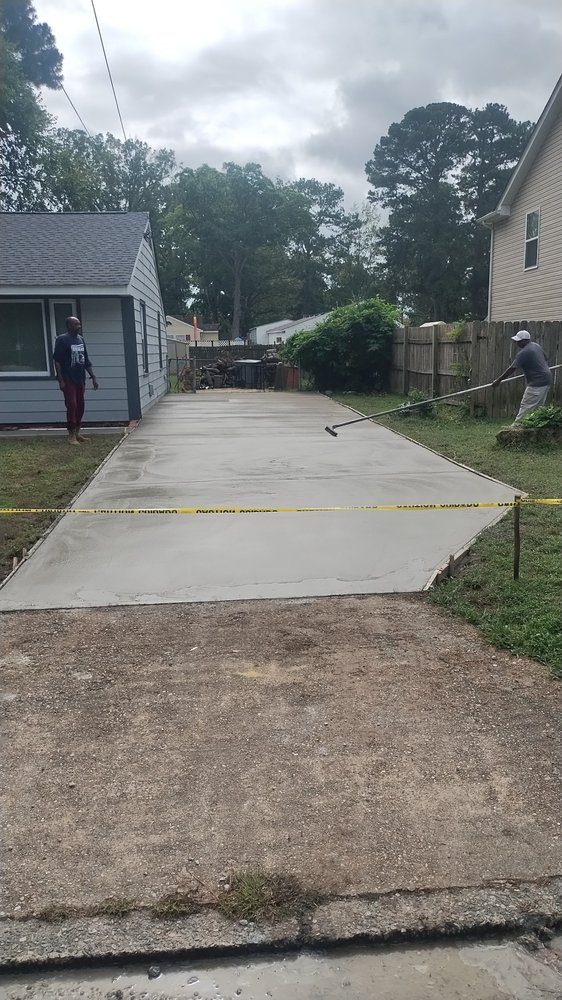
What a driveway job involves
Most driveway work falls into one of four shapes. A new pour where there has never been concrete. A replacement where the existing slab has cracked, settled or spalled past the point where patching helps. An extension, where a driveway is lengthened toward the back of the property or out to a garage or shop. And a widening, where a single width drive becomes a double, or a parking apron gets added alongside.
Each of those starts the same way, with grade and drainage. A driveway slopes for a reason, and the slope has to carry water away from the garage and away from the house rather than toward either. On a flat lot that is a question of a few inches over a long run, and getting it wrong is not something that shows up until the first hard rain.
Thickness comes from what will sit on it. A driveway that only ever sees passenger cars is a different slab from one that takes a truck, a trailer, an RV or a delivery vehicle. It is worth saying at the start if anything heavy is going to use it, because thickening a slab at pour time is cheap and doing it afterward means tearing it out.
Base preparation is most of the job
The part of a driveway that decides how long it lasts is the part nobody sees. Excavation to depth, removal of soft or unsuitable material, and a compacted base placed underneath the slab. Concrete is strong in compression and weak in bending, so a slab that is properly supported across its whole area holds up, and a slab bridging a soft spot cracks at the soft spot.
This is where most cheap driveways go wrong, and it is invisible in a quote. Two prices for the same driveway can differ by a third and the difference is entirely below the surface. A slab poured over whatever was already there will look identical for about two years.
In this region the base question is sharper than it is inland. Sandy soils drain well but carry load poorly when they are loose, and a high water table means a subgrade can be saturated when it is dug. Where that happens, the right answer is more excavation and more compacted stone rather than more concrete on top of a bad base.
Jointing, reinforcement and finish
Concrete cracks. The whole job of jointing is deciding where. Control joints are cut into the slab on a spacing that suits the thickness and the shape of the pour, and they are cut on time, because a joint cut a day late has already lost the crack it was there to control. Isolation joints go where the driveway meets the garage slab, a sidewalk or a foundation, so the two can move independently.
Reinforcement is placed and supported at depth. Steel lying on the subgrade is doing nothing for the slab above it, which is one of the more common shortcuts on a residential pour and one of the harder ones to spot once the concrete is down.
Broom finish is the standard for a driveway and it is the right answer almost every time. It gives traction when wet, it wears well, and it hides the small surface variation that any slab poured outdoors will have. Decorative finishes are available where a project calls for one.
Working around the house you live in
A driveway replacement takes the way you get to your house out of service for a stretch, and that is worth planning rather than discovering. Demolition and removal come first, then base work, then the pour, and then the slab needs time before anything drives on it. Foot traffic comes back sooner than vehicle traffic does.
Pours get scheduled around the concrete and around the weather rather than around the calendar. Summer heat here shortens the working window and pushes starts earlier in the day. Cold slows the set. A date gets committed with that in mind rather than promised and then moved.
Questions
Common questions
How long before I can drive on a new concrete driveway?
Foot traffic comes back well before vehicle traffic does, and full strength takes considerably longer than the point where a slab looks finished. You get the specific timeline for your pour before the work starts, since it moves with the mix, the thickness and the weather that week.
Can you extend or widen an existing driveway?
Yes. Extensions and widening are common work. The new section gets tied to the existing slab with an isolation joint so the two can move independently, and the elevations get matched so the transition does not create a lip or a place where water sits.
Does a cracked driveway have to be fully replaced?
Not always. It depends on what caused the cracking. Surface cracking from shrinkage is different from a slab that has broken because the base underneath it failed. If the base is the problem, patching the surface buys a short time at best and replacement is the honest answer.
How thick should a residential driveway be?
It depends on what will drive on it. A driveway that only carries passenger cars is built differently from one that takes a truck, an RV or a trailer. Say at the start if anything heavy will use it, because building for it at pour time costs very little and adding it later means starting over.
Do you handle the demolition of the old driveway?
Yes. Cutting to a clean line, breaking out the old slab and removing it are part of a replacement scope, and the subgrade underneath gets corrected at the same time rather than being poured back over.
What time of year is best for a driveway?
Most of the year works in this region. Summer heat shortens the working window and means earlier starts, and a hard cold snap can stop a pour outright. Neither rules out a season, they change how the day is planned.
Tell us what you are looking at
Call, or send it through the form with the location. Either reaches the same person.